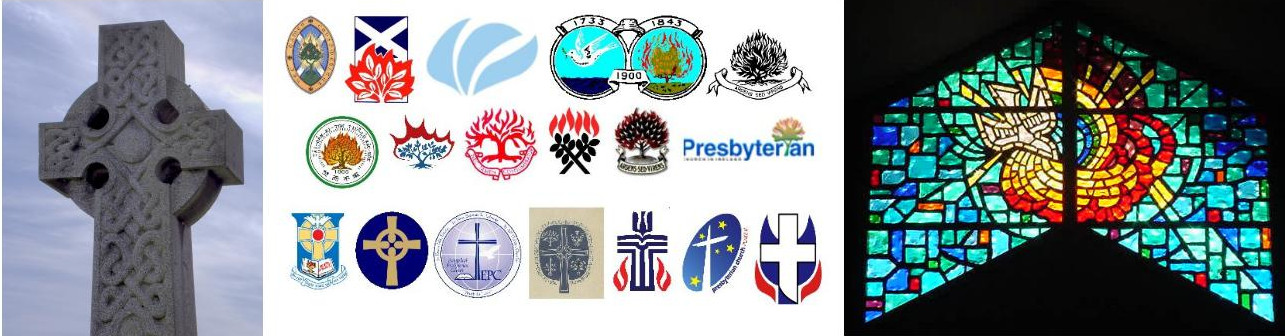
The 219th General Assembly of the Presbyterian Church (U.S.A.) — Recommendations Of The Committee On Ecumenical Relations Regarding The Evangelical Presbyterian Church

The report from the General Assembly Committee on Ecumenical Relations with their Recommendations Regarding the Evangelical Presbyterian Church has been released and it is “interesting” reading in a number of senses of the word.  This report to the 219th General Assembly of the Presbyterian Church (U.S.A.) resulted from a referral from the 218th GA .  The opening paragraph of the report probably does as good a job as I could summarizing how we got here:

This report comes in response to an overture from the Presbytery of Peace River to the 218th General Assembly (2008) of the PC(USA) that would have asked the World Alliance of Reformed Churches (WARC) to investigate the role of the Evangelical Presbyterian Church (EPC) in persuading PC(USA) congregations to disaffiliate from the PC(USA) and be dismissed to the EPC. The assembly referred the overture to the General Assembly Committee on Ecumenical Relations, which appointed a task group to make recommendations.

So it is looking at the “role” of the EPC.  Going back to the original overture it asks of the Assembly:

The Presbytery of Peace River respectfully overtures the 218th General Assembly (2008) of the Presbyterian Church (U.S.A.) to request the Executive Office of the World Alliance of Reformed Churches to investigate the actions and conduct of the Evangelical Presbyterian Church, as described below, and to take appropriate action.

The described “actions and conduct” are:

The Evangelical Presbyterian Church is actively pursuing a strategy to persuade Presbyterian Church (U.S.A.) churches to disaffiliate with the Presbyterian Church (U.S.A.) and be dismissed to the Evangelical Presbyterian Church.

The Evangelical Presbyterian Church has created a transitional presbytery to facilitate the process.

So this began not with the “role” of the EPC but with two specific complaints – “a strategy to persuade” and creating “a transitional presbytery.” The report addresses this in the Findings section at paragraph VI.4.l:

l.    There was no evidence that the EPC took the initiative in entering PC(USA) congregations to speak against the PC(USA), for the EPC, or about affiliation with the EPC. However, there was ample evidence that when invited by a session or pastor, EPC representatives went in without consultation with the appropriate judicatory within the PC(USA) and spoke freely.

OK, there is the answer that the presbytery asked for in the overture – The Evangelical Presbyterian Church did not initiate but did not discourage.  So now that we have the answer we can now turn off the lights, lock the door, and go home, right?  “By no means” — we are Presbyterians so there are 15 pages of report to document this and present recommendations to try to patch up relations with the EPC, acknowledge the pain of separation within the PC(USA), and try to find ways to do better in the future.

OK, having gotten my snarky comments about “mission creep” out of the way, let me begin again by saying that I found a lot to like in this report.  It is precise and accurate about many historical and polity points, a feature I appreciate.  That said there are some aspects that bother me but these are mostly in what was left unsaid.

It is worthwhile to begin the detailed analysis with the remainder of the Preface which makes a very important distinction in this:

The task group met with presbyteries in which congregations had departed the PC(USA), with pastors and members of congregations who had departed or were considering departing the PC(USA) including those affiliated with the New Wineskins Association of Churches, and with leadership of the Evangelical Presbyterian Church. In listening to people’s stories and in reviewing documents, the task group sought to distinguish between actions of Evangelical Presbyterian Church, and actions of the New Wineskins Association (which consists of PC(USA) pastors and members, as well as former PC(USA) pastors and members who are now affiliated with the EPC).

The distinction is important in that the actions of the New Wineskins members can be considered matters internal to the PC(USA), at least at their root. Actions of the EPC, on the other hand, are matters between churches—churches that are both members of WARC. It is this latter category that is the focus of the original overture. The report that follows presents the findings of the task group regarding activities that are internal and external to the PC(USA), and presents recommendations on how the PC(USA) should move forward in its relations with the EPC.

I very much appreciate the tone throughout this report that this is a very complicated issue and that the EPC as a denomination must be viewed as an independent player despite the fact that it has the New Wineskins Transitional Presbytery.  It is also important to remember, and this is one of the points that I think is passed over too lightly in the report, that the New Wineskins Association of Churches is a broad organization with members, individual and congregational, that have a wide range of opinions about departure from the PC(USA).  Any categorization of the NWAC should be done carefully.  The disaffiliation portion of the strategy report must not be viewed as the guidelines for all the members.

Maybe the historical point I most appreciate is the honest appraisal of the origin of our two denominations (V.1):

The histories of the EPC (with its organizing General Assembly in 1981) and the PC(USA) (with its organizing General Assembly in 1983) are deeply woven together, particularly since a large number of the congregations and ministers making up the EPC in its formative years had previously been a part of the PC(USA) or its predecessor bodies. Both the EPC and the PC(USA) lay claim to deep roots within the Presbyterian and Reformed traditions of the larger Christian family tree.

Yes, the EPC and the PC(USA) share the same root stock in American Presbyterianism, we are not some distant cousins but very close siblings.  And yes, the EPC predates the PC(USA).  And the report shares the vision of the EPC from its founding – “From those beginnings, however, the EPC was determined to grow by planting new congregations.” (V.3)

This section goes on to discuss the “trust clause” and I must compliment the Task Group on their historical footnote on the legal basis for it.  (And some of the members of the special committee I was on thought one of mine was long )  The report says of the differing perspective of the two denominations (V.3):

The EPC had developed a denominational understanding of property that is substantively different from the understanding in the PC(USA). The EPC and its leadership see no reason for holding onto congregations, ministers, or real property if those assets will help those persons to be more effective in their mission. In this area, the EPC’s ecclesiology differs significantly from the PC(USA)’s.

And later (VI.5.b) the report says this about the disagreements over the trust clause:

b.  During the task group’s visits, the issue that garnered the most theological—and legal—disagreement was that of the PC(USA)’s property trust provision in Chapter 8 of the Book of Order. What was debated among the NWI/NWAC’s national leadership played out “on the ground” in local congregations regarding property. Those desiring to leave saw this as a violation of their conscience, and their understanding of the nature of the church. The PC(USA) loyalists defended the ownership of property under the trust provision as biblical and held in Presbyterianism long before the explicit Book of Order clause. The different ecclesial understandings of the two denominations led to disagreement not only around ordination standards, property, and theology, but also around the meaning of congregational independence and connectionalism/congregationalism.

As I read this report I kept thinking that the task group, and often the denomination as a whole, seems to miss the tension inherent in the trust clause and only concentrates on the ultimate communal ownership of the property.  Yes, we have the trust clause (G-8.0200)

All property held by or for a particular church, a presbytery, a synod, the General Assembly, or the Presbyterian Church (U.S.A.)… is held in trust nevertheless for the use and benefit of the Presbyterian Church (U.S.A.).

But the question that I don’t hear asked as loudly, here or anywhere, is why do we have the concept of the trust clause to begin with?  While the language of the trust clause itself was inserted to make the concept explicit following a U.S. Supreme Court Decision (see that historical note ) the report and a PC(USA) OGA Advisory Opinion (#19) are correct in pointing out that it intrinsically flows from our view of the church as a connectional system.  We belong to each other not because we chose to belong but because Christ calls us together.

But this is then viewed in the light of why Christ calls us together and in Chapter 3 of the Book of Order titled “The Church and Its Mission” it says (G-3.0400) “The Church is called to undertake this mission even at the risk of losing its life, trusting in God alone as the author and giver of life, sharing the gospel, and doing those deeds in the world that point beyond themselves to the new reality in Christ.”  And regarding the list of responsibilities of the presbytery all relate back to the opening statement that (G-11.0103) “The presbytery is responsible for the mission and government of the church throughout its geographical district.”  The tension of holding property is to be good stewards so it does the most good for building the Kingdom and furthering the mission given us by Jesus Christ.  I’m not sure we are as good as we could be about “a time to keep and a time to let go.”  In light of the ultimate call to forward the Kingdom, and acknowledging the theology behind the trust clause, I see no reason that the line from the report could not be rewritten to say “The PC(USA) and its leadership see no reason for holding onto congregations, ministers, or real property if those assets will help those persons to be more effective in their mission.”  In both branches the property is for the purpose of mission, the branches differ as to which governing body has responsibility for discerning the best use of the property in furthering mission.

Following from that the most meaningful part of this report, to me, is the section of the findings that demonstrate how our “keeping” and “letting go” need some work.  Here are excerpts from the report:

j.    In several cases, both New Wineskins representatives now in the EPC as well as PC(USA) representatives said that when presbytery processes were followed, the outcomes were better than if a congregation entered into litigation against the PC(USA) presbytery. In every instance where the civil courts were involved, representatives of both New Wineskins and loyalist PC(USA) leaders said it became extremely painful. (VI.2.j)

b.   The size of the congregation was often a driving factor in the approach to discussions and the process for departure. Smaller congregations with fewer human and real property assets were often more easily resolved. In other cases, especially when the congregation was larger, the presbyteries recognized the need to be immediately engaged, and the situation often led to civil litigation, resulting in very large costs—emotionally and financially—for all involved. (VI.4.b)

c.   In general, those congregations that followed an ecclesiastical process… fared better. Although it depends upon the state, courts generally have sided with the PC(USA)’s understanding of Chapter 8… In some cases, departing congregations relying on a legal strategy alone or in concert with an ecclesiastical one, lost additional money or property, and would have been much better off without civil action. Situations that involved a higher degree of trust and communication usually resulted in a negotiated settlement with which all parties could live and still feel respect for one another. Some of these situations even seemed to result in what was perceived by many as a “grace-filled” process. (VI.4.c, emphasis mine)

Friends, the single most important thing I took away from this report was those two final lines.  We need to remember the “trust clause” is ultimately there for advancing mission and nothing else.

Having said that I want to highlight one more plus and one more negative I see in this report and then get on with the recommendations to the 219th GA.

First, looking beyond the trust clause and discussing Presbyterian connectionalism in general, the report does a good job of developing the concept that congregations must be dismissed to another body.  There is no such thing as an independent Presbyterian church within the Presbyterian understanding of the church.  For those not familiar with the issue at hand, the EPC New Wineskins Presbytery is a transitional presbytery and is simply a place that a congregation can momentarily stop on their journey.  While there may be an intent to join a geographic presbytery there is also the possibility of being released as an independent congregation.  Unless the relationship is fixed and not transitional the PC(USA) understanding of the relationship finds it wanting.  (Now I want to go back and look at how churches transferring into PC(USA) non-geographic presbyteries were handled since those were also intended to be transitional presbyteries with limited life times.)

Second – On the one hand I found the report refreshing in the acknowledgement of the existence and role of what have come to be called the “Louisville Papers.”  These are documents put together by the Stated Clerk’s office to help guide presbyteries in the legal work of property disputes.  It is important to remember that they are legal memos and read as such.  They are strongly worded and have the touch of a lawyer out to win his/her case.  I talked about all this back in August 2006 when they were made public by the Layman.

The report also makes a big deal of a document that in some ways serves a similar role produced by the New Wineskins Association of Churches, New Wineskins Initiative: A Time for Every Purpose Under Heaven.  It is a publicly released document that talks about the future of the NWAC and in part acts as a guide for NWAC churches for the disaffiliation process.  Section VI.5 of this task group report says “The task group’s findings in local situations regarding a desire for ‘theological clarity’ mirrored the language of the New Wineskins Initiative’s national spokespersons.”  The report also constantly refers to the various disaffiliation options mentioned in the strategy paper.  What I did not see in the report was the view from the other side — when viewed from the perspective of a church trying to depart the PC(USA) the legal action taken by a particular presbytery followed the advice in the “Louisville Papers.”  Now I agree that the legal documents covered the full range of responses so basically anything the presbytery did could be seen as following that guide, but what the report does not say is that each side saw the other as having their own strategy piece.

Most of the Findings in the report were gathered from visits to presbyteries where members of the task group spoke to the presbytery leaders as well as leaders and members of churches, including disaffiliated churches, in that area.  It is worth noting that the group visited nine presbyteries out of around 40 that one list shows having churches that disaffiliated or considered doing do.

There is a lot more in the report but having covered the major points I got out of it let me turn to the recommendations.

1.   Affirm that

a.   the Presbyterian Church (U.S.A.) is in correspondence with the Evangelical Presbyterian Church, by virtue of our common membership in the World Alliance of Reformed Churches;

b.   our common membership in the World Alliance of Reformed Churches is a visible sign of our oneness in Jesus Christ; and

c.   as members of the body of Christ, we are all called to treat one another as followers of Jesus Christ.

2.   Request the World Alliance of Reformed Churches to create guidelines offering basic protocols for interactions and behaviors between its member denominations.

3.   Call the Presbyterian Church (U.S.A.) to

a.   confess to the rich tradition of freedom of conscience that we claim as Reformed, Presbyterian Christians, and

b.   recognize that this same tradition causes us to be prone to separation, demonization of those with whom we disagree, and a captivity to insistence on our own rightness.

4.   Invite the Evangelical Presbyterian Church to enter into such a season of confession with us.

5.   Acknowledge the unique complexity of the relationship between the Presbyterian Church (U.S.A.) and the Evangelical Presbyterian Church, given the fact that the ecclesial roots of many churches, members, and ministers now in the Evangelical Presbyterian Church lie in the Presbyterian Church (U.S.A.) and its antecedent denominations.

6.   Invite the General Assembly of the Evangelical Presbyterian Church to engage in bilateral dialogue concerning various dimensions of the relationships between the two denominations and its member churches, members, and ministers; and that a report from this dialogue be made to the 222nd General Assembly (2016), with an interim report made to the 221st General Assembly (2014).

7.   Direct the Office of the General Assembly to develop resources to support presbyteries with congregations and/or ministers engaged in a process of discernment or undergoing the process of dismissal, in light of denominational learnings in the recent past.

8.   Acknowledge the deep pain caused by the experiences of congregations departing or going through schism and of ministers departing, and call upon synods to consider developing care teams to listen to people’s stories, thereby enabling healing, with presbyteries also urged to extend extra care during such vulnerable times of congregational and presbytery life.

9.   Encourage presbyteries, congregations, and individual families who experience the pain of separation to recognize that there is more than one way to understand the same event and to pray for one another through our shared faith in Jesus Christ.

I will not analyze these recommendations on a point-by-point basis but take an overview of them generally.  It is important to note that they all reflect a sense of restorative and not punitive church discipline.

Having said that, I have to admit that after reading the report I am very surprised at the nature of the recommendations.  The first six recommendations, some with sub-points, of the nine total (two-thirds of them) in one way or another touch on the PC(USA)’s relationship with the EPC.  While the report discusses the NWAC very heavily there is only a light treatment of the EPC role in the text as a whole and the findings in particular.  The process says there was a meeting with four representative of the EPC but I did not see any discussion of how that meeting went, specifics of the discussion, or any formal or informal agreements mentioned in the text and therefore don’t see from where these recommendations derive.  After having had bi-lateral contact why do the recommendations have such a unilateral nature to them?  While I don’t expect a specific agreement with the EPC in the recommendations, I was searching the text for some indication of how these invitations would be received.  Yes, at present the PC(USA) GA action would be an invitation from us, but the body of the report characterizes the current situation only from the perspective of the one side.  Can it give us an indication of how the EPC would take the invitation “to enter into such a season of confession with us”?

So I don’t see the same proportionality of rational in the text as I see in the recommendations and from the information in the body of the report I have having trouble “connecting the dots” to arrive at what is asked in the recommendations.

I really like recommendation #2 that would have WARC create the “guidelines offering basic protocols for interactions and behaviors between its member denominations.”  As the history of this situation shows the PC(USA) and the EPC have been operating with different expectations and procedures for the exchange process and to somehow come to a standard understanding would be helpful for all involved and may help relieve pain and confusion that result when different bodies have different expectations.  The report says (VI.3.a)  “In various conversations with PC(USA) presbytery representatives, their expectation that normal, standard ecumenical courtesy would be extended by local or national EPC judicatory leaders was repeatedly frustrated.”  Is “normal, standard ecumenical courtesy” something that is codified somewhere (Miss. Manners for the Ecclesiastical?) or an unwritten set of expectations that can vary from denomination to denomination even in the Reformed stream?  It appears to be the latter if WARC is being asked to develop these.

Similarly, I appreciate #7 which would have the church develop resources that are pastoral rather than legal.

Finally, I think the task group did a good job with recommendations 8 and 9 that acknowledge the pain involved in these events and encourage everyone to recognize that “there is more than one way to understand the same event” and to deal with this in a pastoral manner.

UPDATE: The EPC has now issued a press release saying it is “grateful” that the task group find the accusation unsubstantiated.  It with holds additional comments until after the GA acts on the report.

So this report took 15 pages to not only answer the original question but to look at the whole mess, and yes it did get messy, and to provide us with a perspective and lessons from what has happened and recommendations to help heal the pain and move on with being the Church.  With that in mind let me return to, and close with, one of those quotes that made the report for me.  Remember, the 218th GA also called us to a “Gracious Separation” and it is not just what we do but how we do it that is a witness to the world.  This report has much to support that Gracious Separation —  And the world is watching .  From section VI.4.d:

In those situations where matters went to civil court… the time, energy, and money expended on both sides was enormous. Some New Wineskins leaders who sought membership in the EPC expressed that if they had it to do again, they would likely follow an ecclesiastical process with the presbytery. Likewise, the presbyteries that had to respond to civil action, or that chose to initiate it, regretted the court costs and intervention into the life and work of the presbytery. Court proceedings were universally perceived as draining of the financial and other resources of the presbytery. Also, what trust might have been present prior to legal proceedings was often ruptured once those proceedings began.

The 219th General Assembly of the Presbyterian Church (U.S.A.) — Brief Updates For Late April

Just a few news headlines that have come up recently regarding the 219th General Assembly of the Presbyterian Church (U.S.A.).  No analysis now but maybe later:

  • The leadership for the 19 committees has been named .  I have gone through the list and recognize a few of the names and think I see some interesting trends.  If I get around to doing the analysis statistically then I’ll report on what I find.
  • Speaking of committees the 19 committees are posted on PC-Biz and business is being assigned to each of them.  In what I consider a good move there are two “Social Justice Issues” committees, one for “Promotion of Social Righteousness” and one for “the Exhibition of the Kingdom of Heaven to the World.”  In the past the Social Justice committee always had a heavy and controversial work load.  Good move to split it up.  However, these committees are not to be confused with the separate committees on Peacemaking Issues and the Middle East.  In addition there are a bunch more on all the usual suspects including Church Orders, Marriage, Form of Government Revision, Church Polity.  I think you can tell a lot about a Presbyterian branch by the committees it keeps.
  • Business keeps getting added to PC-Biz.  We are at 108 Overtures and 77 recommendations.
  • Twitter is starting to come alive.  Moderator of the 218th GA, the Rev. Bruce Reyes-Chow, has put together a list of twerps twitter users who will be tweeting from the 219th GA.  It appears that the hashtag will be #ga219.  (Note that the hashtag #ga2010 will be used at least for the Church of  Scotland GA next month and maybe others.)  The official tweeps include Bruce (@breyeschow ), Randy Hobson (@randyhobson ), Thomas Hay the Director of Operations (@DirofOp ), and twitter handles for @PresbyGA and @ga219tracker. And there is a great article by Robert Austell on “What is Twitter and what could it mean at the Presbyterian General Assembly .”
  • Speaking of Twitter, there is a report I have found only there via @DirofOp that there is a third candidate for Moderator.  I will write more once I have been able to confirm this. (Looking at the timing I suspect that the individual has session but not presbytery endorsement.)  UPDATE: As I was writing this the Layman published an article about the Rev.
    Maggie Lauterer
    from the Presbytery of Western North Carolina who will become the third moderator candidate if elected as a substitute commissioner and endorsed for moderator at their meeting on Tuesday April 27. Anticipating the fourth candidate will be endorsed the following week by Northern Waters I will comment on both following the second endorsement.
  • Finally, at the present time I am pretty sure that I will not be attending GA in person this year, only in the virtual world.  I have been given the opportunity to teach Summer Session and have accepted that offer because if there is anything I like more than a General Assembly it is Earthquakes.  I still plan on posting as much as possible here on the blog and will be commenting on Twitter as well @ga_junkie .

More shortly…

Approaching The General Assembly Of The Church Of Scotland

While not the first General Assembly meeting of the GA season, the General Assembly of the Church of Scotland is pretty close, convening in Edinburgh one month from today on May 20, 2010.  In the last few days various news items, some only tangential to the GA meeting, have been circulating in the Scottish press.  Here is a quick run-down:

Probably the most significant from a polity viewpoint is the debate on ordination standards, specifically as to what the place in the ordained ministry is for same-gender partnered individuals.  While the discussion and debate of the place of same-gender relationships in the Kirk has been circulating for a while now, the relationship to ordination standards came to the fore last year with the Assembly creating the Special Commission on Same-sex Relationships and the Ministry. This commission is not scheduled to report back until next year but it has the charge to consult with every presbytery and has developed a consultation paper for the session and presbytery discussions.  This paper sets forth the background and process for governing bodies to enter into this discussion.  There are four questions for discussion, #1 dealing with the Biblical witness, #2 talking about Approaches to Same-sex Relationships, #3 about ordination/leadership in the church, and #4 the Unity of the Church of Scotland.  The document provides a discussion of each of these to form the basis for group discussion.  The process then asks the body to vote on questions 2, 3, and 4 by secret ballot.  According to the Commission’s time-table this consultation process is almost over, intending to have it wrapped up by the end of May.  And being part of the official process it is not subject to the Kirk’s moratorium on public discussion .

This process has hit the news in the past few days for two reasons.  The first is that the special meeting of Greenock and Paisley Presbytery to debate the questions in the consultation is taking place today (probably as I am writing this in fact) and has been picked up by local press outlets — Inverclyde Now and Herald Scotland.  A couple of interesting quotes from the media reports.  Inverclyde Now says:

This level of consultation is almost unprecedented in the Church of Scotland and could involve the Special Commission in collating tens of thousands of responses.  The results will form part of their report to the General Assembly of 2011 at which the Kirk’s understanding of same-sex relationships in the ministry will be decided.

And Herald Scotland gives the historical perspective:

The issue of gay ordination threatens the greatest schism in the Church since 1843, when one-third of its body left to form the Free Kirk.

In a slightly amusing story from yesterday the Herald Scotland says:

The Herald has obtained a copy of a crucial consultation document that outlines for the first time the route the Kirk has taken to help members decide on the issue.

As best as I can tell this is the same consultation report available on the web site .  I have not been checking but I don’t think it just appeared today since the Commission has been using it for all of the consultations.  But maybe the Herald Scotland did get the scoop and it was only just posted.  I don’t know.  They do comment that the document seems reasonably broad, even if some of the descriptions are “not great.”

As I mentioned before, this Commission report is not due to GA for another year so I am not sure what if any related business will be on the docket — The agenda and reports are not posted yet.  However, it is certain that this will be on many commissioners’ minds next month and may raise its head in interesting places.

The other item of GA business that got some press coverage last week was the Church and Society Council‘s involvement in suicide prevention, especially teen suicides, as part of a national government campaign.  Maybe I am reading too much into this, but I think that I hear echoes of the National Youth Assembly 2008 deliverance on Healthy Relationships in here.  The key item in this program is to make available to everyone basic training in skills of recognizing a potential problem and working with a person to get help.

OK, there you have a couple of the high-profile business items which may or may not be in play at the Assembly.  In other Assembly news… The Garden Party is no more (at least not this year).  Traditionally The Lord High Commissioner hosts a Saturday afternoon Garden Party at Holyroodhouse that has been a fixture of the Assembly as long as anyone can remember. (Brief YouTube Video )  Well this year the event will not be held for cost savings reasons and other social functions will be scaled back as well.  The Scotsman reports :

The Queen’s representative to the General Assembly, the Lord High Commissioner, normally hosts the event for ministers, Kirk elders and other invited guests from across Scotland.

But after a cut in the commissioner’s budget for assembly week from the Scottish Government, the party has been axed as part of a savings drive that has also resulted in a scaling back of official dinners held at Holyroodhouse.

The Saturday afternoon garden party, thought to cost about £20,000 to stage, was widely regarded as one of the highlights of the Kirk’s social calendar.

However, reader’s comments posted by the Edinburgh Evening News seem favorable to the cutback considering current circumstances.

Finally, there is another news story that is more tangential to the Assembly and probably only hit the press because of the celebrity of the individual involved and possibly his sexual orientation.  There are stories circulating, I’ll point to the one from Pink News , about actor and gay rights campaigner Alan Cumming being asked to leave the Church of Scotland.  The story quotes Cumming as saying:

Writing in an online question and answer session with fans, he said: “It was more about tradition, habit, the thing to do. Then I began to realise that my being a part of it was only condoning and validating lots of things I disapprove of: oppression, guilt, shame etc.

“I began to talk about my lack of belief in the press, because, just like gay rights, I think more people need to speak out to highlight hypocrisy and fear.

“The Church of Scotland wrote to my mum and said they had read something about me being an atheist and would I like to leave the church, and I did. So I was excommunicated.”

The story also says:

A Church of Scotland spokesman told the Herald: “We have no knowledge of this. Such a decision could be made at the discretion of an individual congregation’s Kirk session.”

As I read this the information is slim but it just sounds like good Presbyterian polity to me — the session that had responsibility for him had questions about his Christian faith and appear to have made the inquiry of that faith and suggestion that if he did not agree with the Kirk’s doctrine he might consider removing himself.  There is no mention at all of any ecclesiastical judicial action which I would take to be a formal excommunication.  That appears to be the term he uses, not the term used by the Kirk.

UPDATE: As I was writing this Queerty posted a story titled “Is Alan Cumming Exaggerating About Being Excommunicated From Church of Scotland?” with one comment so far supportive of the exaggeration view.

Anyway, we are getting close to GA.  The Twitter hashtag #ga2010 is in use and there may be others.  I am watching for the agenda, reports and blue book to get posted and I’ll let you know as soon as I see that they have been.

EPC Report Of The Interim Committee On Women Teaching Elders

The Evangelical Presbyterian Church has released the Report of the Interim Committee on Women Teaching Elders1 and it is a document that polity wonks will want to have a look at.  It lays out a rational for the EPC to structure itself in light of its motto “In essentials, unity; in non-essentials, liberty; in all things charity”2 to accommodate the ordination of women in some congregations and presbyteries. Now you may not agree with the committee’s analysis and recommendations, and in fact the report acknowledges that some people won’t when it says:

The interim committee does not advocate running from this potential conflict but heading into it with humility and a conviction that we will honor God by treating one another respectfully. The unique ethos of the EPC on women’s ordination intrinsically implies that not all Presbyterians will be comfortable with our ecclesiastical arrangement.

The report begins with a review of the situation in the EPC.  The first line says “A guiding principle of the EPC from its beginning has been our declared intent to allow liberty on the women’s ordination question.”  The second paragraph sets out the polity basis for this stance:

At the beginning, we must acknowledge the fundamental principles that inform the EPC’s liberty on women’s ordination. The Biblical Principle: The Holy Scriptures are the inspired Word of God, the only infallible rule of faith and practice. This authoritative Word is true in all that it teaches. The Ecclesiastical Principle: Women’s ordination is a non-essential issue about which faithful believers may have honest differences of biblical interpretation and practice. One’s view of women’s ordination is not an essential element to the catholic faith, Evangelical Protestantism, or the Reformed Tradition. The EPC has always affirmed that women’s ordination is a matter of biblical interpretation, not biblical authority.

So the committee sets forth at least two important Presbyterian principles here — The primacy of Holy Scripture and the freedom of conscience in the matters of non-essentials.  (Whether this issue falls into the category of essential or non-essential we will return to later.)

Another Presbyterian principle the committee bases their recommendations on is the right and responsibility for electing officers:

The particular church has the right to elect its own officers” (§BOG 7-2). This right is guaranteed in perpetuity to all churches in the EPC. Similarly, the authority of presbyteries to determine their membership is granted in the constitution.

So given these principles as the doctrinal basis the committee makes three recommendations:
 
1) Reaffirmation of the EPC Position on Women’s Ordination
The committee recommends making the denomination’s stance as set forth in the Position Paper explicit in the constitution :

Recommendation: That BOG §2-2 be amended by adding an excerpt from the EPC Position Paper on the Ordination of Women to the existing statement. The amended BOG §2-2 would read:

The Officers of the Church as set forth in Scripture are: Teaching Elders (designated by many titles in Scripture, including Ministers and Pastors), Ruling Elders, and Deacons. The Evangelical Presbyterian Church does not believe that the issue of the ordination of women is an essential of the faith. Since people of good faith who equally love the Lord and hold to the infallibility of Scripture differ on this issue, and since uniformity of view and practice is not essential to the existence of the visible church, the Evangelical Presbyterian Church has chosen to leave this decision to the Spirit-guided consciences of particular congregations concerning the ordination of women as Elders and Deacons, and to the presbyteries concerning the ordination of women as Ministers.

The rational argues that while the Position Paper has functioned as justification of BOG §7-2 “it would be appropriate to insert these succinct excerpts from the Position Paper into the constitution.”  They also point out that there is precedent for doing something like this from when the document Essentials of Our Faith was incorporated into the constitution.

2) Transfer of Congregations to Adjacent Presbyteries for Reasons Regarding Women as Teaching Elders

The interim committee recognizes the tension inherent in our polity regarding the ordination/election of women as Teaching Elders. Basic polity rights can actually compete with one another in presbyteries on this issue. The right of the congregation to elect its officers and the authority of the presbytery to examine persons for a position as Teaching Elder can create conflict. A congregation may elect a woman as a Teaching Elder while a presbytery may decline that call due to the majority interpretation of Scripture on this issue. This creates an obvious tension that we would like to resolve.

The committee goes on to recognize the situation of a congregation transferring into the EPC through the New Wineskins Transitional Presbytery with a female TE in place.  So how does the denomination provide this liberty within the structure of the geographic presbyteries?  The committee writes “We desire to provide freedom for these congregations without compromising the constitutional authority exercised by presbyteries.”

In this section the committee provides only general guidance for changing the BOG not specific wording like Recommendation 1.  For this recommendation part A suggests “In specific cases, for reasons related to the prohibition of the ordination or reception of women as Teaching Elders, a church may petition a geographically adjacent presbytery for membership.”  This would require all the usual approvals that we Presbyterians are familiar with for transferring presbyteries — request by the session with explicit reasons regarding this ordination issue, approval by the receiving presbytery and approval by the dismissing presbytery, both by majority vote.  And the wording of the recommendation is clear that congregations with positions on either side of the issue could request to transfer.

The second part of this recommendation addresses churches entering the denomination through either transitional presbyteries or directly.  The proposal is that the BOG would provide for the church to first consult with the geographic presbytery they would be within and “If, after such consultation, the presbytery discerns the need for relief for the entering congregation on this issue, then it will contact the adjacent geographic presbytery and recommend admission of the church”

3) Immediate Relief for a Presbytery in Conflict
Finally, this committee arose from a specific overture at the last General Assembly by Mid-America Presbytery to permit the Presbytery to act as two parallel presbyteries in the same geographic area.  The committee recommends dividing the Presbytery into two geographic presbyteries roughly along the Mississippi River with the expectation that one would permit ordaining/electing women Teaching Elders.

Discussion:
If you are tracking the debates in the PC(USA) and the PCA over ordination standards you have probably already read this document with one or the other or both of those branches in mind.  Here are my thoughts…

The issue of presbytery membership is the easier one to discuss and for the EPC with their tradition of “local option” the recommended relief seems to make a lot of sense.  I have not analyzed the pattern of presbyteries to see how far a church would have to “reach” to find a compatible presbytery, but one could envision the membership patterns becoming a checker board with fuzzy boundaries between the “yes” and “no” presbyteries.  If this recommendation is adopted it will be interesting to see how much this becomes a point of consideration in the future in forming new presbyteries like it is part of the thinking in Recommendation 3.  In other words, will there be consideration of whether a “permissive” or “restrictive” presbytery is needed in a particular geographic area.

It is interesting to compare this with the proposals coming to the 219th General Assembly of the Presbyterian Church (U.S.A.) that call for flexible presbytery membership and an alternate synod structure.  It strikes me that this EPC proposal tries to preserve the geographic nature of presbyteries to the maximum extent possible, something not a prominent in the PC(USA) proposals.

The other issue in this proposal is what is essential, or how ordination standards are “Biblical Principles” and not subject to “honest differences of biblical interpretation.”  The Presbyterian Church in America is clear that the ordained offices of elder and deacon are open only to men based upon the witness of Scripture.  The discussion that is ongoing in that branch is about interpretations and practices that are nibbling around the edges of that doctrine regarding the participation of women as commissioned helpers of deacons.

The situation in the PC(USA) is the opposite and they have inherited a stance from the former United Presbyterian Church that the ordination of women is an essential.  Knowing that this post was in the works, at the very end of my last post I made a cryptic, and probably snarky, comment that referred back to the 1975 General Assembly Permanent Judicial Commission decision in the case of Maxwell v. Presbytery of Pittsburgh, now universally known as the Kenyon Decision.  In that case Mr. Walter Wynn Kenyon was denied ordination as a Teaching Elder because he disagreed with the ordination of women.  He was clear about his declared exception and the fact that he would not participate in the ordination of a woman, but he also said he would not hinder someone else doing it.  Pittsburgh Presbytery approved his exception and cleared him for ordination but the Presbytery decision was challenged.   In the end the GAPJC decided:

The United Presbyterian Church in the United States of America, in obedience to Jesus Christ, under the authority of Scripture, and guided by its confessions, has now developed its understanding of the equality of all people (both male and female) before God. It has expressed this understanding in the Book of Order with such clarity as to make the candidate’s stated position a rejection of its government and discipline.

In the PC(USA) accepting the ordination of women is an essential according to the GAPJC decision.

So what if you read this report and try to imagine it as applying to the PC(USA) and its current controversy which has been cast to be about biblical interpretation of non-essentials and the presbytery’s authority to decide who can be ordained? An ordination standard currently in the Book of Order (G-6.0106b), seen as a “clear mandate” by some , is included in a General Assembly Authoritative Interpretation as something that can be declared by a presbytery as a non-essential.  The overlap and parallel nature of these discussions is striking.

But this discussion in the PC(USA) is not an independent one because it has the shadow of the Kenyon decision cast across it — how is a 1975 decision about what the Book of Order says is essential applicable to the denomination today?  I am not the first to consider this juxtaposition and the Kenyon decision has been cited as one of the reasons for churches leaving the PC(USA) for the PCA and EPC in the 70’s and 80’s over the disagreement of not just the essential itself but over the GA, and not the presbytery, being able to specify that as essential.

On the other hand this new report points to the principle advocated by the recent PC(USA) AI that presbyteries have the right and responsibility for deciding on the suitability of candidates for ordination or election.  Essentially all leadership decisions are to be done under “local option.”  (And again it is noted by some that the Kenyon decision and G-6.0106b properly or improperly raised certain ordination standards to the level of denomination-wide essentials.)

So as I said at the beginning this report crafts a resolution suitable for the “ethos of the EPC,” but a resolution that will not have the concurrence of all Presbyterian polity wonks.  I believe that the committee has done a good job of crafting a solution that fits the circumstances and polity of the EPC.  How the overtures in the PCA and PC(USA) that includes facets of the EPC report recommendations will fare will be interesting to see.  At the present time the EPC model does not fit the polity of these other branches which have some significant internal challenges.  Going forward it will be interesting to see how essentials and non-essentials and unity and liberty are balanced in each of these.  And of course, “In All Things, Charity.”

Footnotes
[1] This link is to a PDF format version I created for easier download. The original is a Word document file available from the EPC web site .
[2] An interesting discussion on the origin of this phrase can be found at http://www9.georgetown.edu/faculty/jod/augustine/quote.html

The 219th General Assembly of the Presbyterian Church (U.S.A.) — The Power Of Interpretation

It is beginning to look like G-13.0103r is going to be a big deal at the PC(USA) GA this year…

This short item in the Book of Order currently says that the General Assembly has the responsibility and power:

to provide authoritative interpretation of the Book of Order which shall be binding on the governing bodies of the church when rendered  in accord with G-13.0112 or through a decision of the Permanent Judicial Commission in a remedial or disciplinary case.  The most recent interpretation of a provision of the Book of Order shall be binding;

Now, I am about to launch into a very polity wonkish review of this section and the role and nature of the Permanent Judicial Commission.  If you are just looking for the bottom line you can skip on down to the discussion of the individual overtures.

Probably the place to begin is considering the judicial process and judicial implications in Presbyterian government.  I am not a specialist on the history of judicial process but a bit of what I have found out is helpful to pass on here.

First, it should be kept in mind that most Presbyterian branches do not have Standing or Permanent Judicial Commissions.  As we saw last spring the General Assembly of the Church of Scotland was presented a complaint and protest from members of a presbytery.  To consider the appeal in a timely manner the Commission of Assembly, not a judicial commission, reviewed it and while they had the power to hear the case and render a decision they decided by a close vote to have the appeal heard by the next General Assembly.  That full Assembly then took an evening and sat as the appellate court for the Kirk.  Likewise, the General Assembly of the Orthodox Presbyterian Church has a time on their docket when they sit as the highest judicial court in their church.  This is the norm for Presbyterian branches.  Back in 2001 the General Assembly of the Presbyterian Church of Australia (the other PCA) changed their procedures to not have a judicial commission and now the full Assembly hears the appeals, dissents and complaints. (Thanks to The Rev. Dr. Paul Logan, Clerk of Assembly, for helping me straighten that history out.)

How the Judicial Commission developed in American Presbyterianism I would be very interested in knowing more about.  I give you a few parts to the story that I am aware of which will be useful as we consider the current news.  First, we know from Charles Hodge’s Constitutional History of the United States of America Volume II that while the highest governing body was the Synod, up to 1786, that body heard the judicial cases from the presbyteries.  However, in 1869, shortly after the north/south split in 1861, the constitution of the Presbyterian Church in the U.S. described synod and the General Assembly being able to refer judicial cases to a commission whose purpose it was to hear the case.  The suggestion of the wording is that these were not permanent or standing but I don’t know what happened in practice.  (As an interesting note, the 1867 wording said that “the cases of ministers on trial for error or heresy” could not be referred to a commission meaning that they had to be tried by the full Assembly.)

I am not aware of a resource to research on-line the constitutional history of the United Presbyterian Church USA/NA so I’ll have to go to the oldest resource I have close at hand and that is the 1970 Book of Order of the UPCUSA.  That Book makes clear reference to a Permanent Judicial Commission but the PJC could only render preliminary decisions and the decision did not become permanent until affirmed by a vote at the next Assembly.  It is interesting that the Presbyterian Church in America , which traces its polity to the Presbyterian Church in the United States, has the provision that its Standing Judicial Commission can file a final decision unless a large enough minority of the members of the Commission file a minority report and then it goes to the full Assembly for their consideration and final ruling.

What we can probably safely draw from this is that judicial commissions developed as a feature of American Presbyterianism between 1786 and 1867 and in the merger of 1983 that formed the Presbyterian Church (U.S.A.) they ended up with the power to render their own decisions in that branch.

Now if the polity wonks will excuse me let me also mention that a “commission” has a very specific usage in Presbyterian polity.  A commission is not a fancy name for a committee, or is that a name for a fancy committee, but rather is an entity created by a governing body to act with the full authority of that governing body to the extent that the governing body authorizes it.  That is why the PC(USA) GAPJC can interpret the constitution, because it is given that power by the General Assembly to do so on its behalf.  And in the UPCUSA that power was not unilaterally given to the PJC but rather all decisions needed to be reviewed and affirmed by the full Assembly.

Now, let me get very specific to the General Assembly Permanent Judicial Commission of the Presbyterian Church (U.S.A.).  Checking section G-13.0103r in the Annotated Book of Order we learn a few interesting and relevant things about its history:

First, this section has more annotations than any other of the paragraphs in the responsibilities of the General Assembly section (G-13.0103) indicating that it has been regularly involved in Assembly discussion and GAPJC decisions.  We also find that this paragraph was added in 1987 to clarify the intent of G-13.0112, which this section references.  The other proposed modifications to this section run the spectrum from limiting PJC interpretation authority (1996 ) to making the GAPJC the only body to provide interpretation (1997 ).  That latter one seems to me to deny the inherent connection between the GAPJC and the full Assembly.  And there was a 1993 amendment rejected which would have returned to the UPCUSA system of the Assembly reviewing and affirming GAPJC decisions as well as rejected requests in 1992 and 2006 for GA interpretations to be ratified by the Presbyteries.  Bottom line as we look at this year’s overtures — We have been here before.

It is also important to keep in mind the recent history of back-and-forth interpretations from GA and the GAPJC.  In 2006 the 217th GA adopted the report of the Theological Task Force on Peace, Unity and Purity of the the Church .  That action included an authoritative interpretation that presbyteries needed to consider candidates’ declared departures from the standards of the church.  Some presbyteries developed their local standards and procedures and when challenged the GAPJC ruled that while each candidate must be considered on a case-by-case basis candidates were free to declare exceptions in belief but not practice.  The 218th GA clarified this AI in 2008 explicitly saying that candidates could declare exceptions in both belief and practice.  Since that GA there have been a couple more GAPJC cases that have clarified the procedures in these cases.  I have often referred to this as a game of ecclesiastical ping-pong.

Having outlined the background detail of this section let us turn now to what is on the docket for the 219th General Assembly of the PC(USA)?

As a reminder paragraph G-13.0103r now reads:

r. to provide authoritative interpretation of the Book of Order which shall be binding on the governing bodies of the church when rendered in accord with G-13.0112 or through a decision of the Permanent Judicial Commission in a remedial or disciplinary case. The most recent interpretation of a provision of the Book of Order shall be binding.

Overture 6 from Mid-South Presbytery would add to this a new last line that says “No authoritative interpretation shall be issued by a General Assembly which amends or alters a clear mandate contained in any provision of the Book of Order.” Their rational for this is brief (one sentence) and states that the intent is to be sure the Assembly has “proper limits to the use of authoritative interpretations.”  The implication in here is that G-6.0106b is a “clear mandate” and Assemblies should not be using a non-amending method to get around it.

On the other hand we have Overture 16 from Presbytery of the Twin Cities Area titled “On Amending G-13.0103r to Reduce Vexatious and Improper Litigation in the Church.”  With a title like that you could probably guess that this amendment asks to eliminate the GAPJC ability to interpret the Book of Order by striking the phrase “or through a decision of the Permanent Judicial Commission in a remedial or disciplinary case.”  Part of the rational for this overture says:

Judicial cases are extremely burdensome and costly to governing bodies of the church. When brought improvidently, they violate our biblical obligation to avoid vexatious or unnecessary litigation (D-1.0103) and are inconsistent with our fundamental theological conviction that we are most likely to discern the true movement of the Holy Spirit when we gather together in General Assembly (G-1.0400). Moreover, the GAPJC is woefully unprepared to do the work of the General Assembly, since it hears only from the parties to the case; does not have the wider perspective afforded by all of the persons and resources that inform deliberations by the General Assembly; and must prepare its decisions within very tight time constraints (a number of cases usually must be decided, immediately after hearings, in only one or two days).

The proposed amendment would affirm our historic polity of collective discernment under the guidance of the Holy Spirit, and put an end to the “culture of litigation” that is growing in the church. It would do so by removing the incentive to pursue fundamental changes in church law through individual court cases. The judicial commissions of the church still could decide particular cases brought before them, as they do now. However, the authority to interpret the Constitution so as to bind the whole church would rest exclusively with the General Assembly.

I could write a whole polity discourse on these two paragraphs (and that might have something to do with why the Bills and Overtures Committee of the Presbytery recommended its disapproval ) but let me note one point here and some more later.  Yes, the litigation is costly not just to the governing bodies but to both sides in the judicial process.  At the present time governing bodies are on both the complainant and respondent (or prosecution and defendant) sides of high profile cases.  I could not agree more that it would be good to minimize costs — but if you want to reduce the cost work on the judicial process in the Rules of Discipline.  At the present time our polity permits, and always has, those that dissent on conscience to have their complaint heard.

Overture 77 from the Presbytery of Arkansas seeks to return the GAPJC interpretations to the process of the UPCUSA polity.  There are multiple changes so permit me to reproduce the proposed language in its entirety (proposed new language in italics):

r.  to provide authoritative interpretation of the Book of Order which shall be binding on the governing bodies of the church when rendered in accord with G-13.0112 or through a decision of the Permanent Judicial Commission in a remedial or disciplinary case,which is approved as an authoritative interpretation by the next plenary session of the General Assembly. The most recent interpretation of a provision of the Book of Order approved by a plenary session of the General Assembly shall be binding; …


Overture 55 from the Presbytery of San Diego does not deal directly with G-13.0103r but is related in a couple of ways.  It seeks to have the General Assembly get out of the business of dealing with controversy by striking G-13.0103q which says that one of the responsibilities of the General Assembly is:

q. to decide controversies brought before it and to give advice and instruction in cases submitted to it, in conformity with the Constitution.

Let me say this… Nice idea – I think many of us would appreciate it if the Assembly did not have to deal with controversy.  However, as the highest governing body in the Presbyterian church the Assembly has been dealing with controversies, with varying degrees of success, for practically the whole 300 year history of American Presbyterianism.  If the GA did not handle the various controversies the issues won’t go away.  We will either become frustrated in trying to deal with them at lower levels or connectionalism would break down and the controversies would have to be dealt with by middle governing bodies.  As much as everyone finds the time spent on these frustrating, our Reformed background says that controversies will arise because of our sinful human nature and it is the historic role of the highest governing body to collectively decide these through discernment of the community.

This overture is also relevant because if successful in the Assembly and the presbyteries concur the sections following will be re-lettered and paragraph r will become q.

Now having laid out the overtures let me make a few comments about the current situation in the PC(USA).  I have to agree that we, as a denomination, have a lot of ecclesiastical judicial cases to be reviewed.  Most Presbyterian branches have two to four a year that have to be heard by the highest governing body and these can be handled by the governing body.  Since the last meeting of the General Assembly the GAPJC has issued decisions in 13 cases.  So the first question is whether a full Assembly could handle that case load and further whether some of those cases could wait the two years between assemblies.

I realize that none of these overtures ask for the elimination of the GAPJC but two of them would modify its authority.  I must admit that taking all interpretation authority away from the GAPJC does not make sense to me.  In rendering some decisions it must interpret the Book of Order, especially if the new Form of Government is adopted and the “operations manual” elements are removed.  Judicial boards, be they civil or ecclesiastical, have the responsibility to “fill in the blanks” when the general nature of legislation must be made specific.  If the Assembly finds it desirable to have better congruence between the PJC and the full Assembly then Overture 77 is the way to go.

On the other hand, just as the PJC, as an extension of the Assembly, must be able to interpret so must the Assembly itself.  It is there to, among other things, resolve controversies so it needs interpretation authority too.  Overture 6 does not take away that power but there could be questions about what is a “clear mandate.”  At face value I have to agree with Overture 6 but have to ask if this needs to be specified and if the idea of a “clear mandate” is clear itself.  The important thing here is that the Assembly must only interpret and not use the power of interpretation as a substitute for the process of seeking presbytery concurrence in matters of faith and doctrine.

But there is a bigger picture here:  In looking at this issue we must not fall into the trap of viewing these entities as independent branches of Presbyterian government as there are sperate branches of civil government.  While the U.S. Government finds its system of checks and balances in three co-equal branches with individual responsibilities a Presbyterian government finds its accountability in its connectional nature as “…presbyters shall come together in governing bodies… in regular gradation” (G-4.0300c)  The horizontal structure of the church is to equip it for mission and it must be remembered that the OGA, GAMC, PJC, and standing committees are nothing more than parts of the General Assembly itself that the Assembly has seen fit to create to help it do its work.  Our accountability is of a vertical nature, as it should be with Jesus Christ as Head of the Church at the top.  And while Jesus is the Head the Book of Order tells us (G-9.0103) that the foundation is the presbyteries – “The jurisdiction of each governing body is limited by the express provisions of the Constitution, with powers not mentioned being reserved to the presbyteries, and with the acts of each subject to review by the next higher governing body.”

The bottom line here is that we should not view the GA/GAPJC relationship as adversarial for the GAPJC is merely a commission of the GA to help it do its work.  Likewise, the GA/Presbytery relationship is one of mutual support in our connectional system and just as the rational for Overture 16 suggests that GA is a larger body and there are greater numbers to discern the will of God than the smaller GAPJC, the same can be said of the GA sending items to the presbyteries for concurrence, not because we are democratic but because it provides an even greater group of elders, ruling and teaching, to discern together what God would have us do.

Post Script:
In this first footnote let me return to the probable cause of these overtures, the on-going ecclesiastical ping-pong game:
1) In the back and forth over Authoritative Interpretations and declared exceptions to the standards and belief and practice it is important to note that the GAPJC has not ruled on exceptions declared by any specific individual.  All of the legal decisions have so far dealt with procedures and timing in the ordination process, not with any candidate’s specific scruple.

2) If the GAPJC were to be denied the ability to provide interpretation, what about previous interpretations?  I presume they would be explicitly adopted or somehow grandfathered in.  But if previous interpretations are no longer binding does this mean that an officer can object to and not participate in, but not hinder, the ordination of women?

Church And State In Scotland And England — The Reformation Still Means Something

Suppose that you are the future head of the Church of England but you want to get married in a different church, in this case one belonging to the Church of Scotland — Big Problem.  Yes, believe it or not the Reformation still means something.

In case you have not been following the British royal gossip, and I hadn’t until it broke into the realm of Reformed theology, the rumor is going around that Prince William, second in line to the British throne, is close to having an announced engagement to girlfriend Kate Middleton.  If true, congratulations to both of them.  The problem that has arisen is that according to The Daily Express

A source told the Sunday Express: “Officials at Buckingham Palace have been under huge pressure from Kate to try to persuade the Queen to agree to a Scottish wedding.

“Scotland will always have a special place in Kate’s heart because that is where she met William and where they spent so many happy years together at St Andrews University.”

Romantic weddings are nice…  However when marrying a future king and head of the state church there is a part of the constitution that requires you to be married in the church you will someday be the head of. Unfortunately for romance 450 years ago the Church of Scotland decided that the church did not need the monarch as part of its structure and declared that Jesus Christ was the Head of the Church.  The British royals have a respected place but not religious position in this National Church.  Word is that they are back to church shopping now that St. Giles has been ruled out.  (There would be something ironic about getting married next to the grave and in the shadow of a statue of a reformer who was not afraid to take the monarch to task.)

There is another interesting twist to this church and state thing, the decision for the Queen to meet the Pope in Edinburgh on his visit in September rather than in London.  Church spokespersons deny any church/state reason for this (from the Scotsman):

The church yesterday also denied conspiracy theories that His Holiness was meeting Her Majesty in Scotland to avoid embarrassing questions over his call for Anglicans to rejoin the Catholic Church.

While the Queen is head of the Church of England, she is only a member of the Church of Scotland, because of the constitutional settlement around the Act of Union.

The practical reason for the location is that the monarch will already be in the neighborhood for her summer holidays.  But it does seem a handy device that since they won’t be in England this will avoid the head of one break-away church having to greet the current head of the church they broke away from and is now open to churches transferring back.

Finally, the fact that the Church of Scotland is also a break-away church as well is not lost on the pontiff, and he recognizes the difference between Presbyterians and Anglo-Catholics.  Back at the beginning of February the Pope met with the Scottish Bishops and had this to say about the Reformation:

The Church in your country, like many in Northern Europe, has suffered the tragedy of division. It is sobering to recall the great rupture with Scotland’s Catholic past that occurred 450 years ago. I give thanks to God for the progress that has been made in healing the wounds that were the legacy of that period, especially the sectarianism that has continued to rear its head even in recent times. Through your participation in Action of Churches Together in Scotland,see that the work of rebuilding unity among the followers of Christ is carried forward with constancy and commitment. While resisting any pressure to dilute the Christian message, set your sights on the goal of full, visible unity, for nothing less can respond to the will of Christ.

It would seem that the Anglican division is seen as less substantial than the Reformed differences — the “great rupture.”  And what is meant by “resisting any pressure to dilute the Christian message” being used in an ecumenical reference is left as an exercise for the reader.

Special Meeting Of The General Assembly Of The Presbyterian Church In Ireland Regarding The Presbyterian Mutual Crisis

The General Assembly of the Presbyterian Church in Ireland just concluded an almost two hour Special Meeting to deal with the crisis at the Presbyterian Mutual Society.

I followed it closely on Twitter but only got the live video stream working at the very end of the meeting so my comments reflect the official tweets from @pciassembly and a couple of other news sources that got their impressions up quickly.

Since my last update two weeks ago when the Special Meeting was called the Northern Ireland Government has been working on a plan to rescue the savers in the Society.  According to today’s Belfast Newsletter the proposed £225m package from the government would include a £175m government loan to the Society Administrator to accelerate payments to investors, and a £50m hardship fund from which the small investors could withdraw up to £20,000.

The call for the Special Meeting says regarding the church:

While not in a position to share a full written description of what they describe as ‘Plan B”, the First and deputy First Minister indicated that it would include a ‘hardship fund’. In addition to a contribution from government, they anticipated that a sum of at least £1m would be forthcoming from the Presbyterian Church in Ireland towards this ‘hardship element’.

The documents for the meeting include the Report and the Supplementary Report for the Assembly — the latter contains the proposed resolutions.

The Assembly was convened by the Moderator, the Rev. Stafford Carson, who called the meeting to order just after 2 pm local time with scripture reading and prayer.  A press report says that about 800 of the 1200 commissioners were present.  According to the official Twitter messages the Moderator offered an apology “on behalf of PCI for the distress and anxiety that the PMS crisis caused to savers” and “The church has not abandoned these people. We hope that this painful experience will not be prolonged much longer.”  He thanked those who have worked hard on behalf of the savers and asked the church to stay united as they work through this.

The Moderator said that while they still hold out hope for a “commercial solution” the possibility is looking “increasingly less likely.”  Consequently, participating in the government plan, the “Plan B” that is referred to, is advisable since it may be the only hope.  He said “We want to ensure that our actions promote and advance, and do not inhibit or prevent, a just solution” and “We must show we are not a reluctant church, being dragged along by Government.”

The Assembly then turned to the business:

Resolution 1 to receive the report of the Panel on the Financial Crisis was received.

The Twitter messages suggest that Resolutions 2-6 were also easily adopted:

  1. That the General Assembly call on all congregations and members to continue in prayer and to offer practical support where possible for everyone who has been affected by financial hardship, including those caught up in the situation of the PMS.
  2. That the General Assembly are acutely aware of the continuing distress of many savers who have been unable to access their savings in PMS.
  3. That the General Assembly welcome the commitment of the Prime Minister to seeking a resolution of the PMS crisis and his acknowledgement of a moral obligation to do so.
  4. That the General Assembly regret the delay and reaffirm the importance of seeking urgently a solution which will, if at all possible, give a full settlement to all claims, whether from “shareholders” or “creditors” and welcome the assurance that the “commercial” solution is still an option.
  5. That the General Assembly commend the efforts of the Northern Ireland Executive, led by the First Minister and deputy First Minister, and encourage all politicians to work vigorously for a successful solution.

There was more discussion when they got to Resolution 7:

That in the event of the government failing to secure a “commercial” solution and the Northern Ireland Executive bringing forward a final and comprehensive proposal which includes a “Hardship” Fund element, the General Assembly agree in principle to contribute £1m.

One tweet quotes the Rev. John Dunlop – “The law does not necessarily serve justice – a hard lesson for us to learn” and then says that he “suggests creditors who are in line to get their money back plus 8% interest, forgo the interest and contribute to shareholders.” There were proposed amendments and word-smithing of the resolution and in the end the Assembly passed Resolution 7 and changed the wording so the end of the resolution now reads “…commits in principle to contribute £1m.”  Earlier discussion made clear that the concept for raising this money would be by voluntary contributions and not an assessment on the church.  (I will also note that the wording of the original in the tweets did not always correspond with the on-line text so there might have been a couple of different versions circulating.)

Finally, the Assembly passed Resolution 8

That the General Assembly instruct the Panel on the Financial Crisis to consider ways in which the necessary finance may be raised for the above contribution and to report to the June Assembly.

and concluded the meeting by singing that great Irish hymn “In Christ Alone.”

There are initial news reports from the Belfast Telegraph and the BBC about the meeting.  And clearly from Resolution 8 this will come back at the regular Assembly meeting in just under two months.

UPDATE:  The PCI has issued a summary of the meeting which contains the final text of the debated and amended resolution:

That in the event of the government failing to secure a “commercial”solution and the Northern Ireland Executive bringing forward a final and comprehensive proposal which includes a “Hardship” Fund element, the General Assembly agree in principle to contribute £1m, while the General Assembly affirm their view that the members of the PMS are thrifty savers and not risk taking investors.

Also, the Moderator has posted the full text of his remarks to the Assembly on his blog .

Presbyterians — Owning The Label

An interesting little news article flashed across my news alerts this morning.  If I am not reading too much into the story it is not only interesting but fascinating.

The news site NorthFulton.com reports that “Church of the Hills Changes names.”  The story lede says:

JOHNS CREEK – The Church of the Hills officially changed its name to Johns Creek Presbyterian Church effective Easter Sunday, April 4.

If you read this the same way that I did the first thing that jumps to mind is that a church with a name that evokes the generic community church concept, maybe one that is trying to be “seeker sensitive,” has changed course and is now embracing its Presbyterian roots and membership.  At the present time that seems to be the exception and not the rule.

Now I may be reading way too much into this news story.  But here is a quick run down of what I have found out.  (And since they are changing their name their web site may be changing as well so some of these links might be broken shortly.)  They are a relatively new church in the growing suburbs north of Atlanta and part of the Greater Atlanta Presbytery, PC(USA).  The news story says that the church “follows many local area businesses in adopting the young city’s name” suggesting recent incorporation of Johns Creek.  The story also quotes the interim pastor, The Rev. Chris Price:

“Our new name better assists newcomers and families who are seeking a Presbyterian church in the Johns Creek area and reinforces our commitment to the Johns Creek community,” explains Johns Creek Presbyterian Church’s interim pastor, the Rev. Chris Price. “Our name has changed, but our philosophy has not. We’re looking forward to strengthening our presence in the city of Johns Creek by continuing to offer residents a strong and balanced community-based, spiritual home that provides fellowship, worship, and extensive outreach programs.”

That quote sure seems to indicate they want to increase their brand as being Presbyterian.

From the history of the church on the web site we find out that it was chartered in 1995 with 100 charter members.  The congregational statistics from the PC(USA) show fairly steady growth from 1998 (about 390 members) to 2008 (855 members).  Worship attendance has not grown as much going from 250 to 390 in the same time period.  Nevertheless, it is a growing congregation in the PC(USA).

At the present time the web site is still under the old name and on the web site the church neither promotes nor runs from the “Presbyterian USA” label, as they use it.  As you can see in the church logo to the right the Presbyterian label is smaller but present.  (I don’t normally insert a graphic like this in my articles but with the name change I expect any links to break so I’ve included it this time.)  Reading through the web site references to the PC(USA) by that name are present but scattered and the presbytery involvement in the planting of the church is acknowledged.

In short, I am left to conclude that the while the congregation and/or leadership was previously accepting of the Presbyterian label it appears that they have decided to now raise its visibility in the community.  And this is based on what I could find quickly and read into it, a somewhat dangerous thing to do.  The Presbyterian affiliation may have been more or less visible than I estimate before this.  The affiliation may be more or less than before with the name change.

[This is about to get a bit off-topic but one thing that did strike me is that there may be a bit of a back story to all this.  You thought I was out on a limb so far, let me put one more item on the table.  In another article in NorthFulton.com from almost exactly two years ago there is the announcement that a new pastor had been called to become a co-pastor with the founding pastor of the congregation.  The article also says that the founding pastor is getting ready to retire so it appears they tried to do the “co-pastor pastoral transition” strategy to get around the vacant pulpit and interim like they have now.  Anyway, two years later neither the name of the called pastor nor the name of the founding pastor are now seen in the staff list, and in fact from comparing the pictures it appears that the pastor they called has now landed in Vicksburg.  This is not to cast any aspersions on what may have caused this turnover — I have chaired COM, I know that things like this happen for good reasons.  But I bring this up only to ask, but not answer, the question of whether the name change may also have been directly or indirectly influenced by the staff changes?]

This story is an interesting contrast to another item today, a post by Dave Sarafolean on Joshua Judges Ruth. That post reminded us of a post by Darryl Hart on his blog Old Life Theological Society about a year ago titled “Too Cool For You? Wither The PCA.”  In that piece Mr. Hart talks about the reasons that one conservative Presbyterian branch might have a church plant near an existing church in another conservative branch.  He suggests:

One possible reason for the inability of PCA Philadelphians to recommendCalvary OPC to Presbyterian communicants in the area is that the PCA,even in some of its more traditional sectors, like Tenth, no longercultivates a sense of being Presbyterian. Instead, what appears to drivethe PCA, and has been doing so since roughly 1995 when Tim Keller andRedeemer Presbyterian Church in New York City became such a phenomenon,is exegeting, engaging, and redeeming the culture. (emphasis added)

And another recent example that I have cited is the Oakfield, NY, church.  What began as the First Presbyterian Church of Oakfield became the Oakfield Independent Presbyterian Church and then the congregation reorganized again as the Oakfield Community Bible Church losing its Presbyterian identity.

So in these days of churches downplaying their denominational affiliations if not distancing themselves from them (remember in my neck of the woods the Crystal Cathedral is Reformed Church in America and Saddleback Community Church is Southern Baptist) it is fascinating to see Johns Creek re-engaging the Presbyterian title.

Reformed Church In America Approves Adding Belhar Confession As A Standard Of Unity

The Reformed Church in America (RCA) announced this morning that the classes have concurred with the General Synod 2009 to approved the addition of the Belhar Confession to the Standards of Unity of the church.

A two-thirds majority of the RCA’s 46 classes have voted to ratify
adoption of the confession, which General Synod 2009 voted to add as a
fourth standard of unity. 
Each classis has engaged in conversation and discernment around this
decision, which requires an addition to the Book of Church Order.
All votes have been reported to the General Synod office, with 32
classes in favor of ratification and 14 opposed.

Doing the math, two-thirds of the classes would be 31, so the approval was close.  And I should point out that a classis (plural classes) in the Reformed Church is a regional grouping of churches like a presbytery in the Presbyterian tradition although your local polity wonk can tell you about some interesting polity differences.

For those in the PC(USA) this is interesting since the Special Committee to Consider Amending the Confessional Documents of the Presbyterian Church (U.S.A.) to Include the Belhar Confession in The Book of Confessions is expected to recommend to the 219th General Assembly the inclusion of the confession in the PC(USA) Constitution.  The process in the PC(USA) will be the same as the RCA with GA approval first and then the concurrence of two-thirds of the presbyteries.  If the presbyteries concur there will be a final approval vote by the 220th GA.

Follow-up To The Oakfield Sale — The Going Price Of An Historic Church Building In Upstate NY

Just a very quick note as a follow-up to my previous post “An Interesting Tale of Stewardship, Property, and the PC(USA) Trust Clause.”

In that post I described the sale of an historic church building at auction back to a new congregation made up of many members of the old congregation, First Presbyterian Church of Oakfield, NY.  In that sale Genesee Valley Presbytery got $50,000 which seems to about cover their legal fees in this whole incident.  The various reports placed the value of the building at greater than $200,000, and probably closer to $400,000.  An anomaly?

It turns out it is not.  VitureOnline reported yesterday, and I don’t think it is a hoax appropriate to the day, that a vacant historic church building in Binghamton, NY, acquired by the Episcopal Diocese of Central New York through trust clause litigation when the congregation that was there departed the Episcopal Church for the Anglican Communion in North America, was sold back in February to the local Islamic Awareness Center for $50,000.  Again, the assessed value of the property was $386,400.  The Diocese saw about the same return on the property as the Presbytery — cash payment of roughly 1/8th the value and no longer having to worry about and care for a vacant building.

For reference, sale of church property below assessment is not unusual.  The Episcopal Diocese of Rochester in June 2007 sold off the All Saints church building, now assessed on the tax rolls at just over a million dollars, for $475,000.  So that sale was at roughly half the value of the property.

So, $50,000 seems to be the going rate for a $350,000 – $400,000 valued unoccupied church building in Central/Western New York.  The macro-economic supply and demand implications are left as an exercise for the reader.